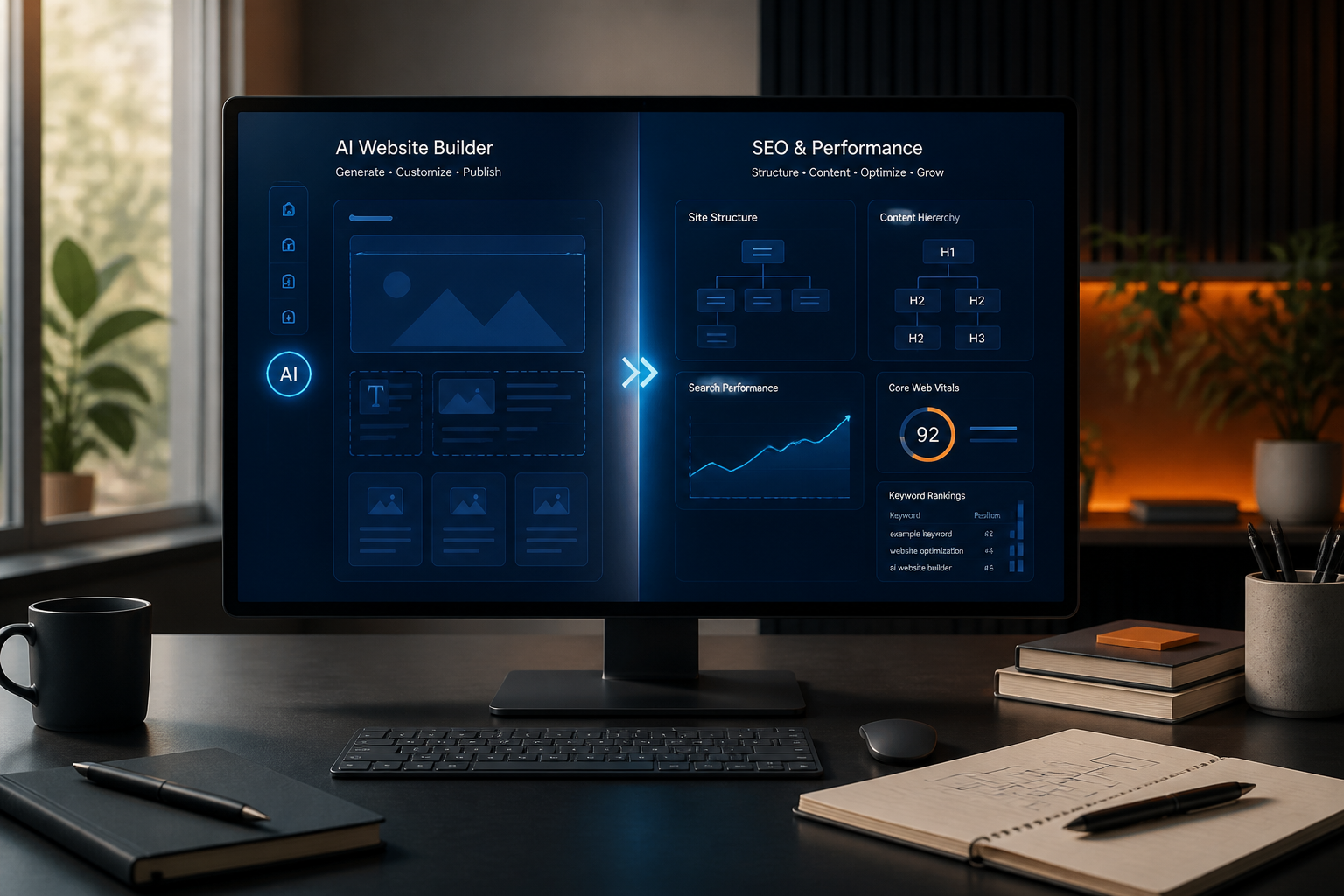
AI website builders are easier to use than ever, and in many cases they are free to try or cheap enough for a business owner to test without a large upfront budget. That part is real. You can now generate layouts, write starter copy, create sections, suggest colours, and even build a rough homepage in minutes.
But there is a second question that matters far more if you want the website to support real business growth: is an AI-built website enough for SEO, credibility, and conversions?
The honest answer is: sometimes yes for speed, no if you stop too early.
For many small businesses, coaches, consultants, local services, and founder-led brands, AI has dramatically lowered the barrier to getting online. It can help you move from “nothing” to a visible first version very quickly. It can also help with idea generation, headline drafts, page outlines, FAQs, service descriptions, and content structure.
What AI does not automatically solve is strategy. It does not fully understand your market, your customer objections, your local SEO opportunities, your sales process, or the exact trust signals that make a buyer choose you over someone else.
Why AI website tools are suddenly everywhere
The demand is obvious. Business owners want websites faster. They want lower setup costs. They want to avoid months of delay. And they want more control over edits after launch.
AI website tools answer those frustrations by making it easier to:
- generate a homepage from a few prompts
- spin up service pages quickly
- test a business idea before investing heavily
- draft content when you are starting from a blank page
- produce a cleaner first version without needing to code
That is why so many people now search for phrases like AI website builder, free AI website builder, build a website with AI, and AI website design tools.
The interest is not hype alone. It comes from a real shift in how quickly websites can now be created.
What AI is genuinely good at in website creation
When used properly, AI can be very useful at the beginning of a web project.
1. Speed
AI can reduce the time it takes to move from idea to draft. Instead of spending days staring at an empty page, you can generate a structure and improve from there.
2. Drafting
It can help produce rough versions of headlines, calls to action, page sections, and frequently asked questions.
3. Idea generation
It helps business owners think more clearly about offers, page layouts, service angles, and content gaps.
4. Low-cost experimentation
If you are still validating an idea, AI can help you test faster before committing to a larger custom build.
Where AI websites usually fall short
1. SEO structure is not automatic
Search visibility depends on more than a decent-looking page. It depends on page hierarchy, internal linking, content depth, metadata, load speed, crawlability, and search intent alignment. If you want a stronger foundation, our SEO guide for small business websites gives a clearer picture of what actually moves rankings.
2. Copy often sounds generic
AI can produce words quickly, but fast copy is not always persuasive copy. If your messaging sounds like every other service business, your website becomes forgettable.
3. Conversion thinking gets missed
A website can be technically live while still being weak commercially. If you have the wrong layout, weak calls to action, unclear proof, or confusing next steps, traffic will not turn into enquiries. That is exactly why common issues like the ones in our guide to website design mistakes that cost customers matter so much.
4. AI does not know your business context deeply enough
It does not automatically know how your buyers think, what objections they have, what local search patterns matter, or what level of trust-building your market requires.
When AI website builders make sense
They can be useful if:
- you need a rough first version quickly
- you are testing a service or offer
- you need a low-cost starting point
- you already know you will refine the site later
When they are not enough
They are usually not enough if:
- your website needs to rank competitively
- you depend on local enquiries
- your positioning needs to feel premium
- your service needs trust signals and persuasive content
- you want the website to become a serious growth asset
The better way to use AI
The smartest use of AI in web design is not as a total replacement for strategy. It is as a speed layer inside a stronger process.
That means using AI to help with:
- drafts
- layout ideation
- content starting points
- research assistance
Then refining the site through real strategy, SEO planning, cleaner design choices, and stronger conversion structure.
If budget is one of the main pressures behind the decision, it is also worth reading our breakdown of how much a small business website costs in the UK so you can compare the true tradeoffs more realistically.
Final verdict
AI website builders are useful, but they are not automatically enough for SEO, credibility, or growth. They are strongest as a starting point, not as the whole answer.
If you want the speed of AI without ending up with a weak digital foundation, use AI to accelerate the early stages and then build the final website around better structure, sharper messaging, and a more deliberate growth strategy.